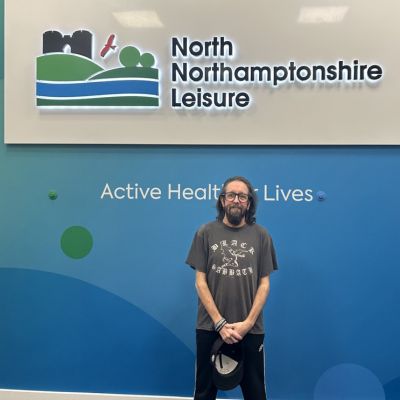
Adam Russell is a 56-year-old record producer and musician based in Kettering, Northamptonshire. Deeply rooted in the heavy metal music scene, Adam owns two recording studios and has spent most of his life creating and producing music. He plays guitar and has always been highly creative, with strong interests in art and tattooing.
Adam is also a proud father of two. His son Jay is a drummer in the band Yard Act, and daughter Millie runs a local business looking after dogs. Before his diagnosis, Adam led a very active and creative life, rarely unwell and unfamiliar with hospitals or medication.
Acting on Early Symptoms Saved Adam’s Life
Adam experienced heartburn over the years however first noticed a change in symptoms in March 2023. Food began to feel as though it was getting stuck in his oesophagus. Drinking water helped initially, but when it happened for the third time, he knew something wasn’t right. He visited his GP, Dr R. Poggi at Weavers Medical Centre, who acted immediately and referred him for urgent tests and scans. Adam credits her quick action with saving his life.
During an endoscopy, Adam expected reassurance – but when he was asked to wait in a side room afterward, he sensed something was wrong. Although doctors could not confirm anything without a biopsy, they explained that the findings looked ‘’sinister’’. The biopsy later confirmed oesophageal cancer.
Adam felt shocked and scared, but one thing kept him positive: the doctors had caught the cancer early, between Stage 1 and Stage 2. Determined not to give up, Adam told himself, “I will fight.”
Before his diagnosis, Adam knew very little about oesophageal cancer. Afterward, he began reading and learning more about the disease.
Treatment Involved Chemotherapy and Complex Surgery
Adam underwent eight chemotherapy sessions, delivered every two weeks over four rounds, followed by Ivor Lewis esophagectomy surgery. He also used natural medicine alongside conventional treatment.
After the first round of chemotherapy, the cancer shrank significantly, and Adam briefly hoped surgery might not be necessary. Unfortunately, despite being very small, the cancer was still present, and surgery went ahead.
The surgery was extremely complex due to the cancer’s location. Surgeons had to operate through Adam’s right side, deflate his lung, and remove two ribs. The operation lasted nine hours. Doctors were more concerned about the surgery itself than the cancer, as the tumour was small and had not spread to the lymph nodes.
Before cancer, Adam’s days were filled with music, painting, and studio work. However, following his diagnosis and chemotherapy, he struggled with extreme fatigue and found it difficult to focus creatively. Painting, once a passion, became challenging – he vividly remembers the first picture he tried to draw after diagnosis and how disheartened he felt by losing his creative “spark.”
Music also paused for a time. Chemotherapy forced Adam to take breaks due to exhaustion, but whenever he felt stronger, he returned quickly to recording. He describes this period as a rollercoaster with emotional and physical ups and downs.
Adam’s initial recovery was positive – he began walking the day after surgery and continued to push himself gently.
A Long Wait for Further Surgery
However, complications arose later. During surgery, his stomach had been pulled too tightly, creating a small hole in the diaphragm that went unnoticed. A year later, doctors discovered Adam had developed a herniated diaphragm, causing his colon to move into his chest. This led to severe pain, breathing difficulties, and a long wait for corrective surgery.
In October 2025, Adam finally underwent a second major operation to repair the diaphragm and reposition his organs. He describes the waiting period as one of the hardest years of his life.
Adam continues to have regular follow-up checks involving CT scans and a camera examination to ensure he remains cancer-free – a process he finds extremely uncomfortable but necessary.
Thankful for Emotional Support and Early Action
Emotionally, Adam experienced many phases. Having never been ill before and avoiding doctors and medication, the hospital environment was overwhelming. Chemotherapy caused him to lose his long hair, which was difficult emotionally.
Adam received outstanding support from Monica Palmer from Macmillan cancer support in Kettering, his cancer nurse, whom he describes as “brilliant.” His family also supported him deeply, although there were days when he needed to be alone.
Adam also reflected on knowing two other people with the same cancer. Tragically, one close friend ignored early symptoms – similar food-sticking sensations – and delayed seeing a doctor. He passed away shortly after diagnosis. This reinforced to Adam how vital early action is.
Recovery and Rehabilitation
Adam was referred by Monica to the Cancer Rehabilitation Programme at North Northants Leisure Centre, where he is attending the ‘We-Can Move Cancer’ Rehab studio-based sessions. He says the programme as exactly what he needed during recovery. You can read more about these sessions in our blog post Rebuilding Strength and Confidence Through Cancer Rehabilitation.
Adam made significant changes to his daily habits: He stopped drinking alcohol completely. He lost a large amount of weight during treatment, dropping from 13 stone to 8 stone, he was advised to increase protein intake and now eats more fish, and he is gradually gaining weight and strength
Adam enjoys cycling and uses a Peloton bike at home, which has helped both physically and mentally. Exercise and the social support of the rehabilitation programme played a key role in rebuilding his confidence and strength.
“I appreciate all the staff at Lodge Park Sports Centre, programs like this are so important both mentally and physically, they have already helped me so much.’’
Adam’s Message to Others
Adam’s advice is clear and heartfelt: “If you start feeling symptoms, you have to go to the doctor.” He strongly encourages people not to ignore signs such as difficulty swallowing or persistent heartburn.
Adam also wants people to know that oesophageal cancer is survivable, especially when detected early. “Be positive. Staying positive is very important. Otherwise, you get dragged down – and I’m sure that makes things worse.”
His message of hope is simple but powerful: “Use your family and friends. They are there to help and support you.”
Adam’s story is a powerful reminder that early detection saves lives, and that strength, support, and positivity can make an enormous difference during and after cancer treatment. By sharing his journey, Adam hopes to encourage others to listen to their bodies, seek help early, and never face cancer alone.