

Oesophageal cancer is often treatable. But like most cancers, the earlier it is caught, the better the outcome usually is. One or more of the following treatments may be used:
Endoscopic mucosal resection (EMR) is where a doctor will remove abnormal cells from the inside of the oesophagus in a similar way to the camera test used to look for the cancer. This may need to be done more than once.
Endoscopic submucosal dissection (ESD) is a procedure used to remove early-stage cancer in the lining of the oesophagus (food pipe). It is similar to EMR but it removes the abnormal area in one segment.
Radiotherapy is a treatment using a high-energy beam of X-rays targeted to a precise area. It can be a stand-alone treatment or can be offered with other treatments, such as chemotherapy.
Chemotherapy could be offered before or after surgery or as a stand-alone treatment. This is a treatment where strong medicine is used to kill cancer cells. There are many types of chemotherapy, but they all work in a similar way. They stop cancer cells reproducing, which prevents them from growing and spreading in the body.
Immunotherapy uses the body’s own immune system to find and attack cancer cells. The cancer cells are tested in the labroratory for specific markers. The results will determine whether immunotherapy, or targeted therapy, could be added to the treatment options.
Surgery is often needed for the oesophageal cancer to be removed completely. The aim of surgery is to remove the tumour, the oesophagus, the lymph nodes (that may contain cancer cells) and the surrounding tissue. It will try to make it so that people can eat and drink in the normal way.
The Ivor-Lewis oesophagectomy is the most performed type of surgery for cancer of the oesophagus. It involves operating in the abdomen and the chest. When the oesophagus or part of the oesophagus is removed, a tube is made from the stomach instead, which is then drawn up into the chest or neck to where it is joined to the remainder of the oesophagus. Patients are usually cared for in an intensive care ward after this operation. In the UK, 87% of operations are performed in this way. Have a look at the diagram below to see how this operation is done.
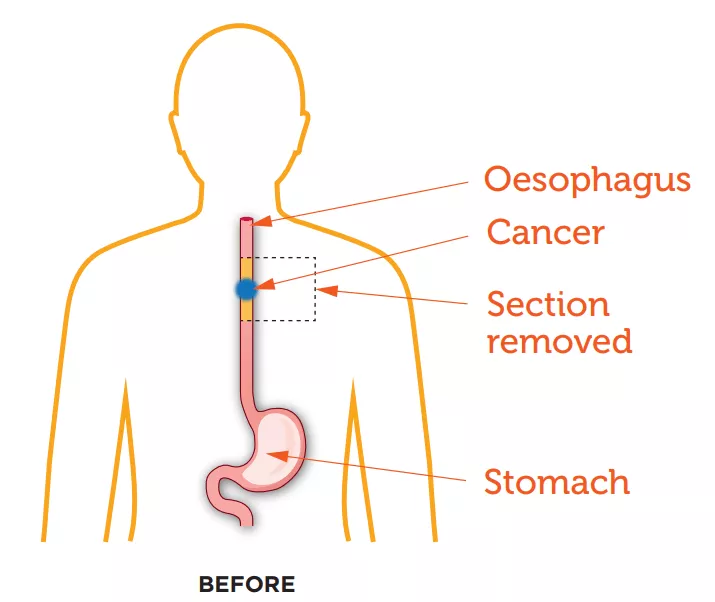
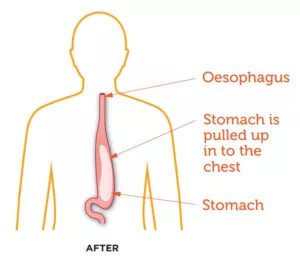
The surgeon may do the operation via keyhole (using instruments fed through a small hole in your skin or – if it’s needed – by making a larger open skin incision). It depends on the location of the cancer and other factors, such as the spread to the nearby lymph nodes. Robotic surgery is also being performed for this type of cancer in a similar fashion to keyhole surgery.
If the cancer is too advanced for treatment that may cure it, the aim will be to improve the length and quality of life for the patient. Doctors may suggest a mix of treatments or no treatment at all, depending on individual circumstances.
If swallowing becomes difficult but surgery is not possible, there are other ways to help.
Endoscopic stent placement is carried out under a general anaesthetic or with sedation by a doctor or specialist in an endoscopy department. A stent (a small tube) is put into the food pipe (the oesophagus) to keep it open and help people swallow food and liquid more easily. The stent is made of plastic or springy metal coil. People who have a stent normally need to follow a strict diet to stop the stent getting blocked by large bits of food. Drinking fizzy drinks after eating can help keep the tube clean and clear.
Endoscopic laser treatment may also be performed by a specialist endoscopist who will use a laser to destroy any tumours growing in your oesophagus.