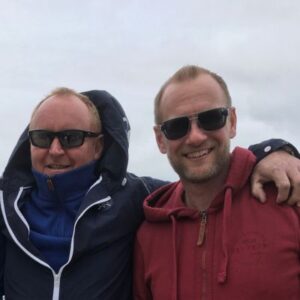


Jenny Mosley, a 56-year-old project manager living near Southampton, lost her 53-year-old big brother Adrian (also known as Ade) to oesophageal cancer in October 2018.
Ade, who Jenny described as vibrant and full of life, had signs of health issues – heartburn, frequent use of antacids and, later on, difficulty swallowing some foods – but dismissed them as minor inconveniences. Ade’s reluctance to seek medical advice, combined with the rapid progression of the disease, left the family shocked and unprepared when he was diagnosed with cancer at an advanced stage.
“Ade was always the life of the party,” Jenny recalls. “He was so full of energy and enthusiasm that it was hard to believe something so serious could be going on beneath the surface.” Ade died just six months after his initial diagnosis.
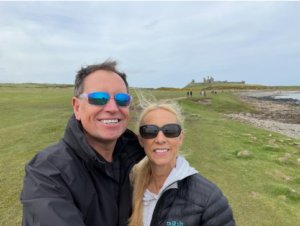
Unknown to Ade, Jenny’s partner, Dave, now 48, had also been experiencing persistent heartburn for over a decade. He was also relying heavily on over-the-counter antacids like Gaviscon to manage his symptoms. “Dave had persistent heartburn for years. Gaviscon was literally a feature on the weekly shop because he was taking it so much,” said Jenny.
However, it wasn’t until Ade’s death that Jenny and her family began to question the normality of such frequent heartburn and its potential link to more serious health conditions. She said: “We take antacids to quell the feeling, but we don’t actually think about the cause of it. “We never connected the dots before,” Jenny admits. “For years, we just assumed Gaviscon was enough, but Ade’s experience made us realise how dangerous ignoring symptoms could be. “If you were taking paracetamol or ibuprofen every day, you’d go to a doctor, but for some reason, we don’t think the same with Gaviscon.”
Ade’s battle with oesophageal cancer
Ade’s cancer journey was swift and devastating. Ade, who had worked abroad as an electrical engineer, on a six-week-on, six-weeks-off rota for years, didn’t even have a UK GP when his symptoms finally became unmanageable.
But by then, the cancer had progressed significantly, leaving limited treatment options, although he did have chemotherapy and radiotherapy, enduring gruelling side effects. His family, despite their best efforts, found themselves navigating a steep learning curve with little guidance or support.
Ade’s death left a massive void but also instilled a determination in his loved ones to prevent similar – avoidable – tragedies from happening to others. “It was heartbreaking to see him suffer,” Jenny says. “He was so brave, even when the treatment took such a heavy toll. We wish we had known more, sooner.”
The turning point
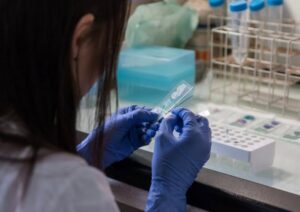
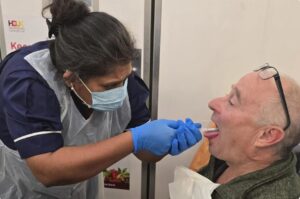
Following Ade’s death, Jenny’s family became more aware of the risks associated with persistent heartburn and its potential link to oesophageal cancer. They discovered Heartburn Cancer UK (HCUK), the UK’s leading specialist oesophageal cancer charity, raising awareness about the condition and promoting early detection tools such as the capsule sponge test. The capsule sponge test is a quick and easy test that can be done for people with persistent heartburn by a trained nurse in a mobile unit or a GP surgery, without the need to go to hospital.
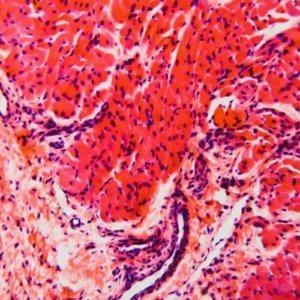
Motivated by Ade’s experience, Jenny registered Dave for a capsule sponge test pilot, with HCUK and the device makers, Cyted. The test revealed that Dave had Barrett’s oesophagus, a potentially pre-cancerous condition that can develop into oesophageal cancer if left untreated.
“Dave had persistent heartburn for at least eight years, maybe 10, before being properly checked. “When we got the results, it was a mix of emotions,” Jenny explains. “Relief that we caught it early. But also fear of what could have happened if we hadn’t taken action.”
Life-saving action
Dave’s diagnosis marked a turning point. Under medical supervision, he began taking Lansoprazole, a proton pump inhibitor, to manage his condition and prevent acid reflux. He will now undergo regular endoscopies to monitor any progression of his Barrett’s oesophagus. The proactive steps taken following Ade’s death have allowed Dave to manage his condition effectively and maintain a high quality of life.
“It’s such a relief to know Dave is being monitored closely,” Jenny shares. “We’ve made lifestyle changes together, and we’re more aware of the importance of staying on top of his health.
“Ade would be delighted to know that he has helped Dave.”