

A pivotal clinical trial of a “pill-on-a-thread” capsule sponge test, which will decide if it becomes a new screening programme for oesophageal cancer, has welcomed its first participants.
The BEST4 Screening Trial
The BEST4 Screening trial will find out if the capsule sponge test could be used to screen people with chronic heartburn for Barrett’s oesophagus – a condition that can lead to oesophageal cancer.
Showcasing UK science and innovation, BEST4 is the last step in a series of clinical trials to see if the capsule sponge test could be offered in oesophageal cancer screening programmes across the UK.
Backed by £6.4 million of funding from Cancer Research UK and the National Institute for Health and Care Research (NIHR), the trial will be led from Cambridge University Hospitals NHS Foundation Trust (CUH) and the University of Cambridge, with the Cancer Research UK Cancer Prevention Trials Unit at Queen Mary University of London designing the trial and analysing results from it.
The Capsule Sponge Test is Faster and Cheaper than an Endoscopy
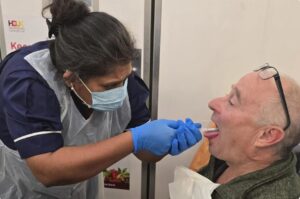
The capsule sponge test takes ten minutes to do and can be done by a nurse – making it much faster and less expensive than endoscopy. The capsule sponge starts off as a small, coated pill attached to a thread. When a patient swallows the pill and it reaches the stomach, the coating dissolves and the sponge inside it expands to the size of a 50p coin.
The sponge collects cells from the oesophagus as it is gently pulled out from the stomach by a nurse or GP. The cells are sent for testing, which identifies cells which are starting to grow out of control and become oesophageal cancer.
The Three Year Clinical Trial will Transform How we Detect Oesophageal Cancer
Over the next three years, the trial will recruit 120,000 people who regularly take medication for heartburn – the most common symptom for Barrett’s oesophagus. Barrett’s oesophagus is a precursor condition to oesophageal cancer, where cells in the food pipe start to grow abnormally.
Invitations to join the trial will be sent by text message from NHSresearch to encourage as many eligible people as possible to take part in England. Participants will be asked to join Heartburn Health, a new platform to take part in clinical trials in heartburn-linked cancers like BEST4 Screening. Mobile screening vans will be rolled out across England to deliver the tests as part of the trial.
BEST4 Builds on Previous Clinical Capsule Sponge Test Trials
The trial follows more than 20 years of research by Heartburn Cancer UK Clinical Trustee and Director Professor Rebecca Fitzgerald and a team of scientists, clinicians and nurses at the Early Cancer Institute, University of Cambridge and Cancer Research UK Cambridge Centre, who invented and refined the capsule sponge test.
Previous trials have shown that the capsule sponge is much more effective at finding Barrett’s oesophagus, a rare condition that can lead to oesophageal cancer, than current options. The BEST3 trial showed that the capsule sponge test picks up 10 times more cases of Barrett’s oesophagus in people with chronic heartburn, compared to routine GP care. Trials have also shown that the test is faster, less invasive and far less expensive than endoscopy, which is currently used to diagnose Barrett’s oesophagus and oesophageal cancer.
To date, over 24,000 capsule sponge tests have been performed in pilot programmes, helping to reduce diagnostic backlogs in endoscopy and NHS pathology.
The BEST4 Trial is Changing how we Detect Barrett’s Oesophagus and Oesophageal Cancer
Mimi McCord, Founder, Chairman, Trustee and Director of Heartburn Cancer UK (HCUK) says:
“It is long overdue that the capsule sponge is adopted into primary care as a triage/screening diagnostic test so that any patient with a positive result could be sent for endoscopy in the hope that an early diagnosis enables curative treatment for a cancer with an appalling prognosis. Anyone with a negative test could be safely returned to the community with peace of mind.”
HCUK Director and Trustee, Director of the Early Cancer Institute at the University of Cambridge, inventor of the capsule sponge test and co-principal investigator of the BEST4 trials, Professor Rebecca Fitzgerald, said:
“The capsule sponge is changing how we detect Barrett’s oesophagus and oesophageal cancer. Catching it earlier can save lives by reducing the need for chemotherapy and surgery to remove the oesophagus. The BEST4 Screening trial is the pinnacle of many years of painstaking research, which has demonstrated that the capsule sponge can reliably identify Barrett’s oesophagus. Thousands of people have already benefited in trials and pilot programmes, and now we’re taking the test to the next level to see if we could offer this to everyone with heartburn. The BEST4 Screening trial could fundamentally transform the lives of people affected by oesophageal cancer by providing the crucial evidence needed to make it a viable screening programme, rolled out to every part of the UK.”
How to Join the BEST4 Trial
The BEST4 Screening trial is open to men over the age of 55 and women over the age of 65 who are currently taking medication for chronic heartburn. The Endosign test used in the trial is manufactured by Cyted Health, who also carry out the pathology tests on samples obtained by the capsule sponge.
More information about how to join the trial can be found at https://best4trial.secureserversites.net/ or by contacting cuh.best4.trial@nhs.net.
You can also sign up to the NIHR’s Be Part of Research service at bepartofresearch.uk to take part in clinical research. Simply answer a few questions about yourself and the conditions you’re interested in to be matched to studies happening in locations near you.